

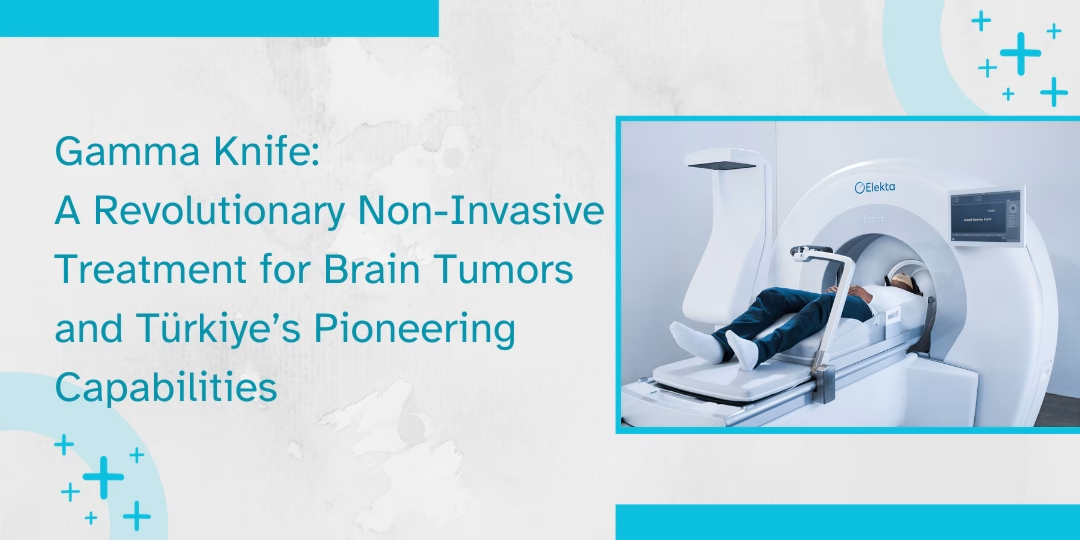
For decades, the diagnosis of a brain tumor conjured images of invasive open surgery, lengthy hospitalizations, and significant risk. While traditional microsurgery remains an essential tool, a quiet revolution has transformed the landscape of neurosurgical care. Gamma Knife radiosurgery, a marvel of medical physics and surgical precision, offers a non-invasive alternative that has changed the lives of hundreds of thousands of patients worldwide. In Türkiye, this technology has found a particularly fertile ground, with a history of pioneering adoption, vast clinical experience, and continuous technological advancement that positions the nation as a global leader in this field.
What is Gamma Knife? The Precision of a Surgeon, The Gentleness of Light
Despite its rather formidable name, the Gamma Knife is not a knife at all. It contains no blades and makes no incisions. Invented by the Swedish neurosurgeon Lars Leksell, the Gamma Knife is a sophisticated stereotactic radiosurgery system that delivers intense, highly focused beams of gamma radiation to precisely targeted areas within the brain .
The core principle is elegant in its simplicity and devastatingly effective in its execution. The modern Gamma Knife Icon device utilizes 192 individual cobalt-60 radiation sources, each emitting a low-energy gamma beam . Individually, each beam is harmless to the brain tissue it passes through. However, these 192 beams are geometrically focused to converge with millimetric accuracy on a single point—the tumor, malformation, or lesion. At this convergence point, the cumulative energy is immense, delivering a therapeutic, ablative dose of radiation that destroys or arrests the target while leaving the surrounding healthy brain tissue virtually untouched .
This anatomical selectivity is the defining advantage of Gamma Knife. The margin of error is as low as 0.15 to 0.2 mm, a level of precision unattainable by conventional radiation therapy and comparable only to the finest microsurgical techniques . It is, in essence, the marriage of computer-guided targeting and radiobiology, delivering “surgery” without a scalpel.
Conditions Treated: A Wide Spectrum of Intracranial Disease
Gamma Knife radiosurgery is not a universal solution for every brain condition, but its application spectrum is remarkably broad and well-established. It is utilized for both malignant and benign pathologies, vascular anomalies, and functional disorders .
Benign Intracranial Tumors:
For slow-growing, non-cancerous tumors, Gamma Knife offers a highly effective alternative or adjunct to open resection. Commonly treated benign lesions include:
- Meningiomas: Tumors arising from the meninges, the protective membranes covering the brain and spinal cord .
- Pituitary Adenomas: Tumors of the pituitary gland that can cause hormonal imbalances or visual disturbances .
- Vestibular Schwannomas (Acoustic Neuromas): Benign tumors of the hearing and balance nerve, where Gamma Knife offers significantly lower risks of hearing loss and facial nerve damage compared to open surgery .
- Craniopharyngiomas, Hemangioblastomas, Glomus Jugulare Tumors, and others .
Malignant Brain Tumors:
Gamma Knife plays a critical role in managing aggressive cancers within the brain.
- Brain Metastases: This is one of the most common applications. Cancer that has spread to the brain from other organs (lung, breast, kidney, thyroid, melanoma) can be effectively treated, often in a single session, even when multiple metastases are present . Peer-reviewed research from Turkish centers confirms that Gamma Knife provides favorable local control for metastatic lesions with minimal adverse effects .
- Selected Glial Tumors: Certain malignant primary brain tumors, such as glioblastomas and astrocytomas, may be treated with Gamma Knife, particularly for small, recurrent, or deep-seated foci .
Vascular Disorders:
- Arteriovenous Malformations (AVMs): Congenital tangles of abnormal blood vessels that pose a high risk of life-threatening hemorrhage. Gamma Knife induces progressive closure of these vessels over 1-3 years .
- Cavernomas: Also known as cavernous malformations .
Functional Disorders:
- Trigeminal Neuralgia: A condition causing severe, electric-shock-like facial pain. Gamma Knife offers a highly effective, non-invasive treatment option for patients who do not respond to medication .
- Movement Disorders: Including tremor associated with Parkinson’s disease and essential tremor .
- Selected cases of Epilepsy and Obsessive-Compulsive Disorder (OCD) .
The Patient Experience: A Single-Day Journey
One of the most compelling aspects of Gamma Knife treatment is the streamlined, patient-friendly experience. The process is typically completed within a single day, and patients are discharged home hours after the procedure .
1. Frame Application and Imaging:
The procedure begins with the application of a lightweight stereotactic frame to the patient’s head. This is performed under local anesthesia to ensure the patient feels no pain. The frame serves two critical purposes: it immobilizes the head with sub-millimeter stability, and it acts as a three-dimensional coordinate system for targeting . With the frame in place, the patient undergoes high-resolution magnetic resonance imaging (MRI), and occasionally CT or angiography, to precisely map the target lesion.
2. Computerized Treatment Planning:
The acquired images are transferred to the Gamma Knife planning software. A multidisciplinary team—comprising a neurosurgeon, a radiation oncologist, and a medical physicist—collaboratively designs the treatment plan. They delineate the tumor boundaries, identify critical adjacent structures (optic nerves, brainstem, cochlea), and determine the optimal radiation dose and beam geometry. This planning phase is the intellectual heart of the procedure, requiring deep expertise to maximize efficacy while ensuring absolute safety .
3. Radiation Delivery:
The patient is positioned on the Gamma Knife couch, and the head frame is docked into the machine’s collimator helmet. The couch slides into the shielded radiation unit, and the 192 beams activate according to the pre-determined plan. The patient feels nothing during this time. The duration of radiation exposure varies based on the size, shape, and number of targets, typically ranging from 15 minutes to over three hours . Throughout the session, the patient can rest and is continuously monitored.
4. Discharge and Return to Normalcy:
Once the radiation is complete, the patient is removed from the machine, the frame is gently detached, and a simple bandage is applied to the pin sites. After a brief period of observation, the patient is discharged. There is no need for intensive care, no open wound, and no prolonged hospitalization. Patients are typically able to resume their normal daily activities the very next day .
The Technological Evolution: Gamma Knife Icon
The current state-of-the-art is represented by the Leksell Gamma Knife Icon. This latest generation device has expanded the capabilities of radiosurgery significantly .
The most transformative innovation is the introduction of frameless flexibility. While the traditional frame-based method remains the gold standard for sub-millimeter precision, the Icon allows for treatment with a thermoplastic mask instead of an invasive frame. This is particularly advantageous for patients who are anxious about frame application, for children, or when treatment needs to be delivered in multiple sessions (fractionated radiosurgery) . The Icon’s integrated stereotactic Cone Beam CT provides continuous, real-time image guidance, tracking the patient’s position with a sensitivity of 0.15 mm throughout the procedure and automatically correcting for any movement .
This adaptability ensures that Türkiye’s leading centers can offer the most appropriate, personalized approach for each unique clinical scenario.
Türkiye’s Capabilities: A Legacy of Pioneering and Volume
Türkiye’s journey with Gamma Knife is not one of recent adoption, but of pioneering leadership. The nation possesses a depth of experience and clinical volume that places it among the world’s most capable destinations for radiosurgery.
A Three-Decade Legacy:
Gamma Knife treatment was first introduced in Türkiye in 1997, a remarkably early adoption of this complex technology . This pioneering spirit was driven by visionary neurosurgeons who recognized the transformative potential of radiosurgery and trained extensively in its application. The establishment of the first Gamma Knife center at a university hospital marked a turning point, rapidly elevating the standard of care for intracranial pathology in the region .
Vast Clinical Experience and High Patient Volume:
The most significant indicator of capability is experience. Türkiye’s leading Gamma Knife centers have amassed extraordinary cumulative patient volumes. Several institutions have individually treated well over 10,000 patients since their inception . One of the pioneering centers, where the technology was first introduced, has restored nearly 12,000 to 13,000 patients to health . Another major private healthcare group has treated over 11,000 international patients since establishing its program in 2006 . This is not theoretical knowledge; it is experiential mastery refined over tens of thousands of cases.
The Unique Synergy: Microsurgery and Radiosurgery in the Same Hands
A distinct characteristic of the Turkish neurosurgical approach is the emphasis on integration. In the majority of global radiosurgery centers, the Gamma Knife is operated by a radiation oncologist, separate from the surgical team. In Türkiye’s premier institutions, a unique model exists where the same senior neurosurgeons are masters of both open microsurgery and Gamma Knife radiosurgery .
This dual expertise has profound implications for patient care. The surgeon is not limited to a single tool; they possess a complete surgical armamentarium. They can objectively evaluate whether a tumor is best removed microscopically in one operation, treated non-invasively with a single session of radiosurgery, or managed with a planned combination of both modalities. This holistic, surgeon-led decision-making ensures that the treatment plan is tailored to the patient’s specific anatomy and pathology, not dictated by the available technology or departmental silos. It represents the gold standard of individualized neurosurgical care .
Advanced Technology Deployment:
Türkiye’s capabilities are anchored in cutting-edge infrastructure. Multiple centers across the country operate the latest Leksell Gamma Knife Icon devices, ensuring patients have access to frameless, fractionated, and high-definition radiosurgery . This is complemented by the presence of other advanced radiosurgery platforms like the Elekta Axesse for stereotactic body radiotherapy, demonstrating a comprehensive national commitment to precision radiation oncology .
Conclusion: Precision, Experience, and a Patient-Centered Ethos
Gamma Knife radiosurgery represents one of the most significant advancements in the history of neurosurgery. It has transformed the management of brain tumors and vascular malformations from a major surgical ordeal into a precise, outpatient procedure. For the patient, it offers the ultimate gift: effective treatment without incision, without general anesthesia, without prolonged recovery, and with minimal disruption to life.
Türkiye has distinguished itself as a true center of excellence in this demanding field. With over 25 years of continuous experience, cumulative patient volumes that rival the world’s busiest centers, and a unique surgical philosophy that integrates microsurgical and radiosurgical mastery in the same hands, the nation offers international patients an unparalleled level of expertise. The combination of pioneering history, vast clinical experience, and the latest Gamma Knife Icon technology ensures that patients seeking non-invasive brain surgery in Türkiye are placing themselves in the care of some of the most capable and experienced teams in the world.
For the patient facing a brain tumor, a vascular malformation, or a debilitating functional disorder, Gamma Knife offers hope. In Türkiye, that hope is backed by decades of proven results and a legacy of healing.
Disclaimer: This information is for educational purposes and is not a substitute for professional medical advice. Gamma Knife treatment should only be performed after a thorough consultation with a qualified neurosurgeon experienced in stereotactic radiosurgery.