

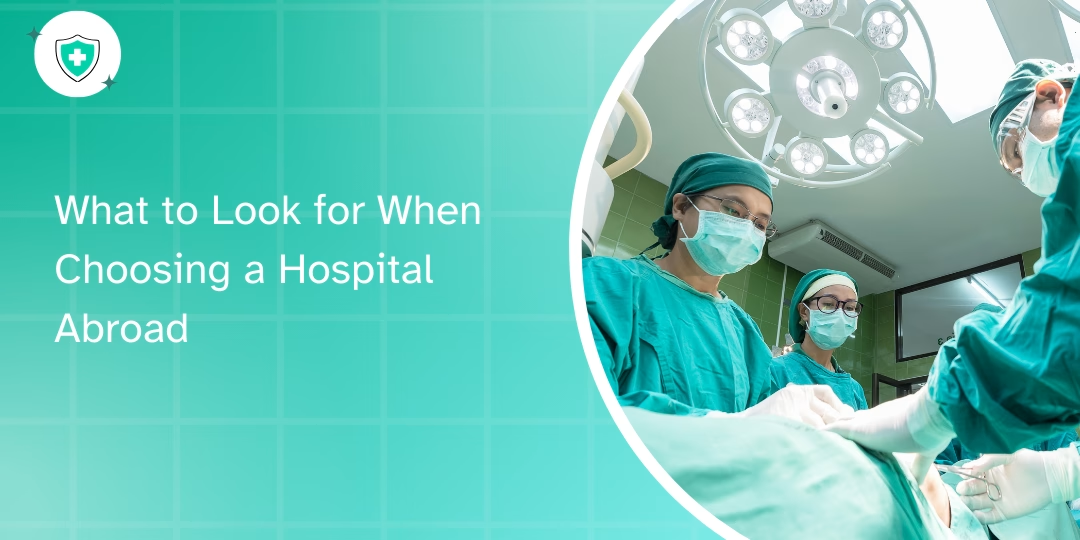
The decision to seek medical care in another country is significant. You are placing your health—your most valuable asset—in the hands of a healthcare system far from home. The hospital you choose will be your medical home during treatment, your recovery environment, and the foundation upon which your entire outcome rests. Choosing wisely is not just important; it is essential.
This guide provides a comprehensive framework for evaluating hospitals abroad, helping you separate genuine excellence from sophisticated marketing, and empowering you to make a decision based on evidence rather than emotion.
Part I: The Foundation—Accreditation and Certification
Before evaluating any hospital’s amenities or patient reviews, start with the most objective measure of quality: accreditation.
What Is JCI Accreditation?
The Joint Commission International (JCI) is the global gold standard in healthcare accreditation. Hospitals that earn JCI accreditation have undergone rigorous, unannounced inspections against nearly 1,300 measurable standards covering:
- Patient safety protocols
- Infection control practices
- Medication management systems
- Facility safety and emergency preparedness
- Staff qualifications and training
- Patient rights and education
- Clinical care pathways and outcome monitoring
JCI accreditation is not a one-time achievement. Hospitals must reapply every three years and can lose their accreditation if standards slip .
Why it matters: When you choose a JCI-accredited hospital, you are choosing a facility whose quality has been verified by independent international inspectors—not merely claimed in marketing materials.
Other Recognized Accreditations
While JCI is the most widely recognized international standard, other accreditations may be relevant depending on your destination:
- ISO 9001: International quality management standard
- Temos International Healthcare Accreditation
- Global Healthcare Accreditation (GHA)
- Country-specific national accreditations (e.g., Australian Council on Healthcare Standards, Canadian Accreditation)
How to Verify Accreditation
Never take a hospital’s word for it. Verify directly:
- Visit the JCI website (www.jointcommissioninternational.org)
- Use their “Accredited Organizations” search tool
- Confirm the hospital’s current status and accreditation dates
If a hospital claims accreditation you cannot verify independently, consider it a red flag.
Part II: The People—Evaluating Medical Staff
A hospital is only as good as the people who work there. Your surgeon is the single most important factor in your outcome.
Surgeon Credentials and Qualifications
Board Certification:
In most countries, physicians should be board-certified in their specialty. For example:
- Orthopedic surgeons should be certified by their national orthopedic board
- Cardiac surgeons should hold cardiothoracic surgery certification
- Plastic surgeons should be certified in plastic and reconstructive surgery
Subspecialty Training:
Look beyond general certification to subspecialty fellowship training. A surgeon who specializes in your specific procedure—knee replacement, not just general orthopedics; breast reconstruction, not just general plastic surgery—brings focused expertise.
Procedure Volume:
Research consistently shows that surgeons who perform high volumes of specific procedures have better outcomes. Ask:
- “How many of these procedures do you perform annually?”
- “What is your complication rate for this specific surgery?”
International Training:
Many leading surgeons in medical tourism destinations trained in Europe, the United States, or other advanced healthcare systems. This training often appears in their biographies.
The Multidisciplinary Team
Modern medicine is a team sport. For complex procedures, ensure the hospital offers a complete team:
- Anesthesiologists with experience in your procedure type
- Intensivists for post-operative ICU care if needed
- Specialized nurses trained in your procedure’s aftercare
- Physical therapists who understand post-surgical rehabilitation
- Nutritionists who can support healing through diet
- Case managers or international patient coordinators
Language and Communication
The ability to communicate clearly with your medical team is non-negotiable. Look for:
- Medical interpreters who are professionally trained (not just bilingual staff)
- English-speaking doctors and nurses (or your native language)
- Translated consent forms and educational materials
- Dedicated international patient coordinators who speak your language
During consultations, assess whether you feel genuinely understood and whether questions are answered completely.
Part III: The Technology—Infrastructure and Equipment
While technology alone cannot replace clinical skill, advanced equipment enables better outcomes for many procedures.
Key Technologies to Consider
For Orthopedic Surgery:
- Robotic-arm assisted systems (MAKO, ROSA)
- Computer navigation for joint replacement
- Minimally invasive surgical capabilities
For Cardiac Surgery:
- Hybrid operating rooms
- Advanced imaging (intraoperative angiography)
- Minimally invasive valve replacement capabilities
For Oncology:
- Advanced radiation therapy (CyberKnife, TrueBeam, MR Linac)
- PET-CT and advanced diagnostic imaging
- Robotic surgery systems (Da Vinci)
For Neurosurgery:
- Intraoperative MRI or CT
- Stereotactic navigation systems
- Gamma Knife or similar radiosurgery platforms
For General Surgery:
- Laparoscopic and minimally invasive equipment
- Advanced monitoring systems
- Electronic medical records for continuity
What to Ask About Technology
- “What specific technology will be used in my procedure?”
- “How does this technology improve outcomes compared to traditional approaches?”
- “Is this technology routinely used, or only available for certain cases?”
Part IV: The Facility—Environment and Safety
Infection Control
Hospital-acquired infections are a serious risk anywhere. Evaluate:
- Infection rates: Ask about the hospital’s infection rates for your procedure type
- Hand hygiene protocols: Observed compliance rates
- Isolation capabilities: For patients with resistant organisms
- Operating room standards: Air filtration, sterilization protocols
Patient Safety Protocols
JCI accreditation requires specific safety protocols:
- Time-out procedures: Verifying correct patient, procedure, and site before surgery
- Medication safety: Bar-coded administration, allergy checking
- Fall prevention: Protocols for at-risk patients
- Emergency response: Code teams, crash carts, emergency drills
Facility Characteristics
- Cleanliness: Is the facility visibly clean and well-maintained?
- Private rooms: Availability for infection prevention and privacy
- ICU capabilities: For complex procedures requiring intensive care
- Emergency services: 24/7 emergency coverage
- Laboratory and imaging: On-site capabilities for rapid testing
International Patient Amenities
While not medically essential, these amenities significantly affect experience:
- Dedicated international patient lounge or floor
- Translation services available 24/7
- Accommodation assistance for patients and families
- Cultural considerations (dietary options, religious accommodations)
- Wi-Fi and communication access
Part V: Outcomes—Data That Matters
What Outcome Data to Request
Hospitals committed to quality track and report outcomes. Ask for:
- Procedure-specific success rates (e.g., graft survival for transplants, fusion rates for spinal surgery)
- Complication rates (infection, bleeding, readmission)
- Patient-reported outcomes (functional improvement, quality of life)
- Length of stay averages for your procedure
- Revision rates (how often patients need repeat surgery)
Understanding the Numbers
Be cautious about interpreting statistics:
- Small numbers may not be statistically meaningful
- High-volume centers often have better outcomes but may take more complex cases
- Risk-adjusted outcomes account for patient complexity—look for these if available
- Compare to published international benchmarks for your procedure
Patient Satisfaction
While satisfaction does not equal quality, it provides insight into the patient experience. Look for:
- Verified reviews on independent platforms (not just hospital website testimonials)
- Comments about communication, nursing care, and support services
- How the hospital responds to negative reviews
- Consistency across multiple review sources
Part VI: The Intangibles—What You Can’t Measure
Cultural Fit
Healthcare is cultural. Consider:
- Communication style: Direct or indirect? Do you feel heard?
- Decision-making approach: Collaborative or paternalistic?
- Family involvement: Is your family welcomed in the care process?
- Privacy expectations: Aligned with your comfort level?
The “Feel” Factor
During consultations—whether in person or by video—pay attention to:
- Do staff seem genuinely interested in you as a person?
- Are your questions answered patiently and completely?
- Do you feel rushed or dismissed?
- Is the environment calm and organized, or chaotic?
Trust your instincts. If something feels off, it warrants further investigation.
Transparency
Quality hospitals are transparent about:
- Pricing (detailed, all-inclusive quotes)
- Credentials (easily verified)
- Outcomes (willing to share data)
- Complications (honest discussions of risks)
Avoid hospitals that are vague, evasive, or pressure you to decide quickly.
Part VII: Practical Questions to Ask
Before You Commit
About the Hospital:
- “What are your current accreditations, and how can I verify them?”
- “How many procedures like mine do you perform annually?”
- “What are your complication and infection rates for this procedure?”
- “Do you have a dedicated intensive care unit? What are its capabilities?”
- “What happens if I need emergency care after hours?”
About Your Surgical Team:
6. “Who will be my primary surgeon? Can I meet them before deciding?”
7. “What are their qualifications and experience with my specific procedure?”
8. “Who will be on the anesthesia team? What are their credentials?”
9. “Who will manage my care after surgery—the surgeon or hospitalists?”
About Your Stay:
10. “What is included in the quoted price? (Hospital stay, surgeon fees, anesthesia, implants, medications, follow-up)”
11. “What is not included? What might cost extra?”
12. “What type of room will I have? Private or shared?”
13. “Can my family member stay with me? What accommodations are available?”
About Follow-Up:
14. “What does post-operative follow-up include?”
15. “How do you coordinate with doctors in my home country?”
16. “Is telemedicine follow-up available after I return home?”
17. “What is your policy if I need additional treatment after discharge?”
Part VIII: Red Flags to Avoid
Warning Signs
- Pressure to decide quickly or pay a deposit immediately
- Vague or evasive answers about credentials, accreditation, or outcomes
- Prices that seem too good to be true (they usually are)
- Inability or unwillingness to provide written, detailed quotes
- Communication only via chat or email—no video consultations
- Surgeon unavailable for pre-travel consultation
- No independent verification of claims (accreditation, outcomes)
- Negative patterns in patient reviews (repeated complaints about same issues)
- Requests to pay large sums to personal accounts rather than hospital accounts
Part IX: The Role of Medical Tourism Facilitators
A reputable medical tourism facilitator can significantly simplify hospital selection by:
- Pre-vetting hospitals for accreditation and quality
- Verifying surgeon credentials and experience
- Providing transparent, all-inclusive quotes
- Facilitating direct communication with potential surgeons
- Offering independent guidance (not tied to specific hospitals by commission)
However, facilitators vary in quality. Evaluate your facilitator using the same criteria you would a hospital:
- What are their credentials and accreditations?
- How long have they been in business?
- Can they provide verifiable references?
- Do they offer transparent pricing?
Part X: Making Your Decision
After gathering information, take time to:
- Compare multiple options: At least two to three hospitals or surgeons
- Weigh all factors: Clinical quality matters most, but experience matters too
- Trust verified data over marketing claims
- Listen to your instincts after thorough research
- Consult your local doctor if possible—they may have insights
Remember that the cheapest option is rarely the best. Value is quality divided by cost—focus on value, not simply the lowest price.
Conclusion: An Investment in Your Health
Choosing a hospital abroad is one of the most consequential decisions you will make about your healthcare. It deserves time, attention, and careful research. The right hospital offers:
- Verified quality through international accreditation
- Experienced surgeons with procedure-specific expertise
- Advanced technology appropriate for your condition
- Comprehensive support before, during, and after treatment
- Transparent communication about everything—costs, risks, and expected outcomes
When you find that combination, you have found more than a hospital. You have found a partner in your healing journey.
Ready to begin your search with confidence? At Chromatic Medical Tourism, we partner exclusively with JCI-accredited hospitals and board-certified specialists whose credentials and outcomes we have personally verified. Our role is to provide the transparent information and expert guidance you need to make an informed choice—then support you through every step of your journey.
Contact us today for a confidential consultation and discover how we can help you find the right hospital for your needs.